|
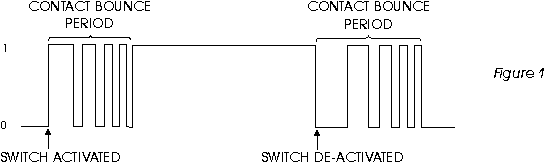
The Definition Push-button switches, toggle switches, and electro-mechanical relays all have one thing in common: contacts. It's the metal contacts that make and break the circuit and carry the current in switches and relays. Because they are metal, contacts have mass. And since at least one of the contacts is on a movable strip of metal, it has springiness. Since contacts are designed to open and close quickly, there is little resistance (damping) to their movement. Because the moving contacts have mass and springiness with low damping they will be "bouncy" as they make and break. That is, when a normally open (N.O.) pair of contacts is closed, the contacts will come together and bounce off each other several times before finally coming to rest in a closed position. The effect is called "contact bounce" or, in a switch, "switch bounce" See Figure 1. Note that contacts can bounce on opening as well as on closing.
The Problem As an example, suppose you want to count widgets as they go by on a conveyor belt. You could set up a sensitive switch and a digital counter so that as the widgets go by they activate the switch and increment the counter. But what you might see is that the first widget produces a count of 47, the second widget causes a count of 113, and so forth. What's going on? The answer is you're not counting widgets, you're counting how many times the contacts bounced each time the switch is activated! The Solution Using Hardware
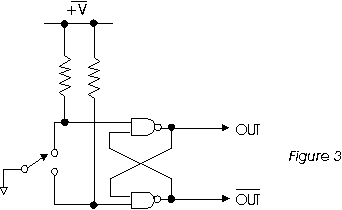
Another hardware approach is shown in Figure 3. It uses a cross-coupled latch made from a pair of nand gates. You can also use an SR (sometimes called an SC) flip flop. The advantage of using a latch is that you get a clean debounce without a delay limitation. it will respond as fast as the contacts can open and close. Note that the circuit requires both normally open and normally closed contacts. In a switch, that arrangement is called "double throw". In a relay, that arrangement is called "Form C".
|