- The Star Topology is common to ARCNet (Attached Resource Computer Network) networks. Every node in a star network is directly connected to a central server, giving it a starburst look. You have to use a bit of imagination and be willing to visualize all the nodes arranged around the server, instead of the reality that they are all located to one side a resemble one-half of a daisy. See Figure #1

Figure #1
- The Ring Topology, which is known more commonly under its commercial name of IBM's Token Ring, creates a network structure in which all the nodes are connected one to another to form a loop that starts and ends at one of the nodes, possibly the server. Like the star, you have to use some imagination to create a ring from the connected nodes. See Figure #2

Figure #2
- The Bus Topology, or Ethernet networking, is the most common network topology in use. If the star truely is a star, and the ring is really a ring, the Ethernet networks are installed in a straight line, called a backbone. I think it's called a backbone because after you attach all the nodes to the main Ethernet line, it resembles the skeleton of a dead fish ------ without the head, of course. See Figure #3
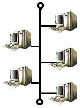
Figure #3
|