|
In the 1980s, the European-dominated International Standards
Organization (ISO), began to develop its Open Systems
Interconnection (OSI) networking suite. OSI has two major components:
an abstract model of networking (the Basic Reference Model,
or seven-layer model),
and a set of concrete protocols. The standard documents that
describe OSI are for sale and not currently available online.
Parts of OSI have influenced Internet protocol development,
but none more than the abstract model itself, documented in
OSI 7498 and its various addenda. In this model, a networking
system is divided into layers. Within each layer, one or more
entities implement its functionality.
Each entity interacts directly
only with the layer immediately beneath it, and provides facilities
for use by the layer above it. Protocols enable
an entity in one host to interact with a corresponding entity
at the same layer in a remote host.
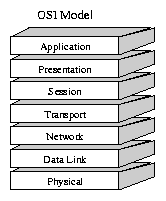
The seven layers of the OSI Basic Reference Model are (from bottom to top):
Phrases that may help you to remember the seven layers
|
Please Do Not Tell Secret Passwords Anytime
|
|
People Design Networks To Send Packets Accurately
|
|
Please Do Not Throw Salami Pizza Away
|
|
Please Do Not Trust Sales People Always
|
- The Physical Layer describes the physical properties of
the various communications media, as well as the electrical properties
and interpretation of the exchanged signals.
* Ex: this layer
defines the size of Ethernet coaxial cable, the type of BNC connector
used, and the termination method.
- The Data Link Layer describes the logical organization
of data bits transmitted on a particular medium.
* Ex: this layer
defines the framing, addressing and checksumming of Ethernet packets.
- The Network Layer describes how a series of exchanges
over various data links can deliver data between any two nodes
in a network.
* Ex: this layer defines the addressing and routing
structure of the Internet.
- The Transport Layer describes the quality and nature of
the data delivery.
* Ex: this layer defines if and how retransmissions
will be used to ensure data delivery.
- The Session Layer describes the organization of data
sequences larger than the packets handled by lower layers.
*
Ex: this layer describes how request and reply packets are
paired in a remote procedure call.
- The Presentation Layer describes the syntax of data being
transferred.
* Ex: this layer describes how floating point numbers
can be exchanged between hosts with different math formats.
- The Application Layer describes how real work actually
gets done.
* Ex: this layer would implement file system operations.
The original Internet protocol specifications defined a four-level
model, and protocols designed around it (like TCP) have difficulty
fitting neatly into the seven-layer model. Most newer designs
use the seven-layer model.
|