NETWORK CABLE
AND CONNECTORS
 There
are several classifications of cable used for twisted-pair networks.
I'll skip right over them and state that I use and recommend Category 5
(or CAT 5) cable for all new installations. Likewise, there are
several fire code classifications for the outer insulation of CAT 5 cable.
I use CMR cable, or "riser cable," for most of the wiring I do. You
should also be aware of CMP or plenum cable (a plenum is used to
distribute air in a building). You may be required by local, state
or national codes to use the more expensive plenum-jacketed cable if it
runs through suspended ceilings, ducts, or other areas, if they are used
to circulate air or act as an air passage from one room to another.
If in doubt, use plenum. CMR cable is generally acceptable for all
applications not requiring plenum cable. There
are several classifications of cable used for twisted-pair networks.
I'll skip right over them and state that I use and recommend Category 5
(or CAT 5) cable for all new installations. Likewise, there are
several fire code classifications for the outer insulation of CAT 5 cable.
I use CMR cable, or "riser cable," for most of the wiring I do. You
should also be aware of CMP or plenum cable (a plenum is used to
distribute air in a building). You may be required by local, state
or national codes to use the more expensive plenum-jacketed cable if it
runs through suspended ceilings, ducts, or other areas, if they are used
to circulate air or act as an air passage from one room to another.
If in doubt, use plenum. CMR cable is generally acceptable for all
applications not requiring plenum cable.
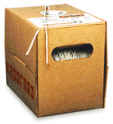 CAT 5
wire is available in reel-in-box packaging. This is very handy for pulling
the wire without putting twists in it. Without this kind of package
or a cable reel stand, pulling wire is a two-person job. Before the
advent of the reel-in-box, we used to put a reel of wire on a broom handle
to pull it. One person would hold the broom handle and the other
would pull and measure the cable. You will produce a tangled mess,
if you pull the wire off the end of the reel. CAT 5
wire is available in reel-in-box packaging. This is very handy for pulling
the wire without putting twists in it. Without this kind of package
or a cable reel stand, pulling wire is a two-person job. Before the
advent of the reel-in-box, we used to put a reel of wire on a broom handle
to pull it. One person would hold the broom handle and the other
would pull and measure the cable. You will produce a tangled mess,
if you pull the wire off the end of the reel.
Stranded wire patch cables are often specified for
cable segments running from a wall jack to a PC and for patch panels.
They are more flexible than solid core wire. However, the rational
for using it is that the constant flexing of patch cables may wear-out
solid core cable--break it. I don't think this is a real concern in
the average small network. For example, I have one solid core
cable going to my work bench. It has probably flexed and average
person's lifetime of flexes from the many many times I have connected
customer computers to my network. Also, stranded cable is
susceptible to degradation from moisture infiltration, may use an
alternate color code, and should not be used for cables longer than 3
Meters (about 10 feet).
Most of the wiring I do simply connects computers
directly to other computers or hubs. Solid core cable is quite
suitable for this purpose and for many home and small business networks.
I find it also quite acceptable for use as patch cables. You might
consider a stranded wire patch cable if you have a notebook computer you
are constantly moving around.
CAT 5 cable has four twisted pairs of wire for
a total of eight individually insulated wires. Each pair is
color coded with one wire having a solid color (blue, orange, green, or
brown) twisted around a second wire with a white background and a stripe
of the same color. The solid colors may have a white stripe in
some cables. Cable colors are commonly described using the
background color followed by the color of the stripe; e.g., white-orange
is a cable with a white background and an orange stripe.
 CONNECTORS.
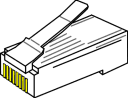
The straight through and cross-over patch cables discussed
in this article are terminated with CAT 5 RJ-45 modular plugs. RJ-45
plugs are similar to those you'll see on the end of your telephone cable
except they have eight versus four or six contacts on the end of the plug
and they are about twice as big. Make sure they are rated for CAT 5
wiring. (RJ means "Registered Jack"). Also, there are RJ-45
plugs designed for both solid core wire and stranded wire. Others
are designed specifically for one kind of wire or the other.
Be sure you buy plugs appropriate for the wire you are going to use.
I use plugs designed to accommodate both kinds of wire. CONNECTORS.
The straight through and cross-over patch cables discussed
in this article are terminated with CAT 5 RJ-45 modular plugs. RJ-45
plugs are similar to those you'll see on the end of your telephone cable
except they have eight versus four or six contacts on the end of the plug
and they are about twice as big. Make sure they are rated for CAT 5
wiring. (RJ means "Registered Jack"). Also, there are RJ-45
plugs designed for both solid core wire and stranded wire. Others
are designed specifically for one kind of wire or the other.
Be sure you buy plugs appropriate for the wire you are going to use.
I use plugs designed to accommodate both kinds of wire.
|