|
Ampere: (A) The basic unit of current flow. Capacitance ( C ): The ability to store electric charge. Units of measure are farads. Conductor: Typically, a metal which will allow current to flow. An Example would be copper wire. Current ( I ): The progressive movement of electrons through a conductor. Current is measured in Amperes. Electron: The negatively charged particle in an atom orbiting the atom's nucleus. Frequency (f): Number of times a periodic waveform repeats itself in a unit time (generally seconds). Units of measurement are Hertz. Hertz (Hz): Unit of measurement for frequency, where 1 Hertz equals 1 cycle per second (cps). Named in honor of Heinrich Hertz, who discovered radio waves. Insulator: Material that will not allow current flow. Some examples would be plastic, glass and rubber. Load: Resistance connected across a circuit that determines current and energy used. Ohm ( W ): The basic unit of resistance: the amount of electrical resistance limiting the current to one ampere with one volt applied. Parallel Circuit: Circuit that contains two or more paths for electron flow supplied by a common voltage source. Resistance: (R) In an electrical circuit, the opposition to electron movement or current flow. Series Circuit: A circuit that contains only one possible path for electron flow supplied by a common voltage source. Shunt: A parallel resistor used to conduct excess current around a meter moving coil to increase range of the meter. See parallel. Switch: A basic control device with the ability to turn a circuit on or off. Volt (E or V representation): Unit of measure of electric potential and potential difference. Example of a typical circuit denoting a source, a conductor, a load and a control: 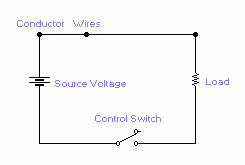
|